


If somebody hummed five particular notes at you, there’s a very good chance you’d think of McDonald’s before they’d finished, and if they sang a certain windscreen company’s name twice in a row, you’d know the tune and you’d probably join in. That’s sonic branding, which is the use of sound, whether it’s a few notes, a sung line, a spoken phrase or a particular voice, to bring a brand to mind without needing to show anything at all.
It can be a tune, a phrase or a voice
When people think of sonic branding they usually think of jingles, but it’s wider than that, and it comes in several forms. The jingle proper is a sung line, where the brand name or the message is set to a tune, and the windscreen company is as good an example as you’ll find. A sonic logo is shorter still, a burst of notes or sound at the end of an advert with no words at all, like those five notes of McDonald’s.
Then there’s the spoken phrase that’s said the same way every time. Tesco’s “Every little helps” and “Should’ve gone to Specsavers” are both good examples, and Gillette’s “The best a man can get” is another. Some of these have become so familiar that people use them in conversation, and when a line gets to that point, it’s working for the brand even when no advert is playing. The ASA’s research into the UK’s most memorable ad slogans shows how many of the best-remembered lines are ones you can hear in your head.
A voice can do the same job, when the same recognisable person is heard on everything you do, and so can a piece of music that you use so consistently it becomes yours. British Airways has used the Flower Duet, from a nineteenth-century French opera, in its advertising since the late 1980s, and plenty of people who couldn’t name the composer know it as the British Airways music. Hovis did something similar in 1973, when it set a slow movement from a Dvořák symphony to pictures of a boy pushing a bike up a cobbled hill. Neither piece was written for the brand, and what made each one belong to it was nothing more than being heard alongside the name, again and again.
Why sound works so well
Sound gets into your memory in a way that pictures often don’t. You can look away from a screen, but you can’t look away from a sound, so it reaches people who are making a cup of tea during the ad break or looking at their phone. It’s quick as well, because a sonic trigger can do in two seconds what would otherwise take a whole advert, and the moment people hear it they remember everything they already know about you.
There’s research to suggest that it’s underused, too. The research company Ipsos analysed more than 2,000 video adverts to see which recognisable brand features did most to get an advert noticed and credited to the right name, and found that sounds were used less often than visual features such as logos and colours, but were on average more effective than some of them. It also found that the features a brand had created for itself, such as characters and its own sonic cues, did better than those borrowed from the wider culture, such as celebrities and well-known music.
That second finding needs reading with some care, not least by us, since licensing well-known music and arranging celebrity endorsements are both things we do for clients. What Ipsos measured was how well a feature gets an advert noticed and credited to the right brand, and on that measure something that’s yours alone has a head start. A famous song or a well-liked face is chosen for a different reason, which is that it arrives with attention and feeling already attached, where a new jingle has to earn them over years. A borrowed sound can also become your own if you stay with it for long enough, as the Flower Duet has for British Airways.
Three ways to get the music, and how we’ve used each
For music, the choice between borrowing and building comes down to three routes. The simplest is a track from a music library, which can do a great deal for an advert. Pulman’s first TV advert, which we made with their agency, JustOut Marketing, runs on the theme “That’s Life” and is based on a vocal track from our library, which set the tone for everything else in it. The limitation is that a library track isn’t exclusive to you, so anybody can license the same one, including your competitors.
The second route is to license a song that people already know, which arrives with years of feeling attached and can make a brand seem bigger overnight. Our animated advert for Hampson Hughes used a cover of Aretha Franklin’s “Think”, on a licence arranged by their agency, Global. A famous song is licensed for an agreed length of time and an agreed set of uses, so settle at the outset how long you’ll want it and where, because going back for more once a song is working for you tends to cost more. There’s a lot more to it than that, which we’ve set out on our music licensing page.
The third is to have something written for you, which is the only route that gives you a sound nobody else has. For AirFair we had a piece of music written specially, so that the campaign had a sound that belonged to it in the same way as its animated characters did. Our composers can write a full track, a jingle with a sung line or a sonic logo for the end of the advert, and there’s more about how it works, including how the music is licensed to you, on our custom music page.
A sound doesn’t have to be music at all. For Windows Plus Roofs, whose advert we made with their agency, WriteSound, a well-known North East actor appeared on screen and provided the voiceover, and that familiar voice became part of what made the brand recognisable.
Whichever you choose, leave it alone
The value of any of these comes from repetition. The first time somebody hears your sound it means nothing, and by the twentieth time it’s yours, but that only happens if you use the same sound, in the same way, every single time, and resist the temptation to freshen it up. It’s one of the hardest things for a business to do, because you’ll be bored of it long before your customers have even noticed it, and the brands with the best-known sounds are the ones that held their nerve. The music behind those five notes was commissioned by McDonald’s for its advertising in 2003, and more than twenty years later the company is still using them.
It follows that the choice at the start deserves some care, because you’ll be living with it. A good sound is simple, and if people can’t hum it or say it after hearing it twice, it’s too complicated. The best ones include the brand name, or say exactly what the business does, which is why the windscreen jingle works as well as it does. It also needs time, so it shouldn’t be judged after one campaign, because these things build over years.
It ties your campaign together
Where a sound of your own really earns its keep is in a campaign that runs in more than one place. If you’re on TV and on the radio, a shared sound is what tells people it’s the same business. On the radio there are no pictures, so the sound is all you’ve got, and if it’s the same one they’ve heard on the telly, the radio advert brings the TV advert back to mind.
The same goes for YouTube, social media and anywhere else you’ve got sound, right down to your phone system’s hold music if you like. Each one reminds people of the others, and the more places your sound turns up, the faster it sticks.
Thinking about your own?
It’s much easier to build a sound into your advertising from the start than to add one later, so it’s worth thinking about before your first advert is made. A sonic logo has to share the closing seconds with your name and your web address, and music that’s written for you can be supplied in versions for 30, 20 and 10-second adverts, so both are best planned along with the script. When you ask us for a free storyboard, we’ll include some thoughts on how your campaign could sound as well as how it could look.
Keep reading.
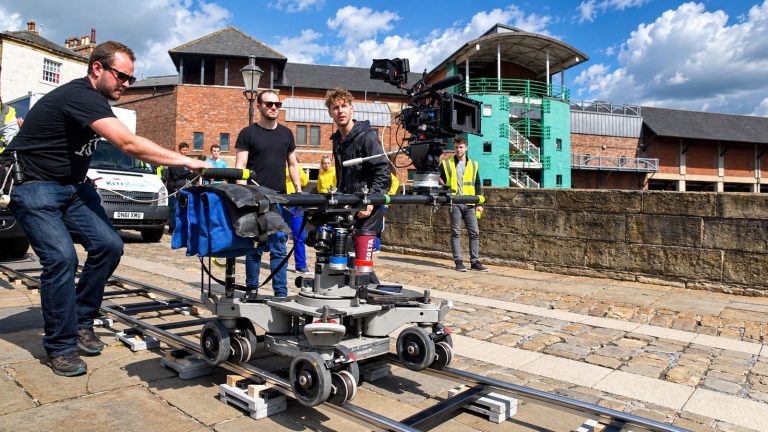
Who does what on a TV ad set? A guide to the crew
DOP, gaffer, grip, focus puller, DIT: a plain-English guide to the people who make a TV advert and what each…

What happens at a TV ad shoot? A guide for clients
If you’ve never been on a film set, the shoot day can be a bit of a mystery. Here’s what…

What happens after the shoot? Post-production explained
Filming is only half the job, so here’s what happens in the edit, what you’ll be asked to approve at…
Ready when you are.
Tell us a little about what you're hoping to achieve and we'll take it from there.
Let's talk about your campaign