


If you’ve never been on a TV ad set before, the first thing you’ll notice is how many people there seem to be, and the second is that you can’t tell what half of them are doing. Everybody has a job title, and titles like gaffer, grip and spark don’t give much away.
It all makes more sense once you know that a crew is organised into small departments, such as camera, lighting, sound and the art department, each with somebody in charge who answers to the director. So here’s a plain-English guide to who’s who, taken a department at a time. Very few adverts need all of these people, and we’ll come back to that at the end.
The people running the shoot
The director is in charge of how the advert looks, sounds and feels. They take the script and the storyboard and decide how each shot will be filmed, and on the day they guide the cast and the crew so that what ends up on screen matches what was agreed.
The producer makes the whole thing happen. They look after the budget, the schedule, the crew, the locations and the paperwork, and they’re usually your main point of contact from start to finish. If the director is responsible for the creative side, the producer is responsible for everything that lets it happen on time and on budget.
The assistant director, often called the AD or the first AD, is the person who runs the set, and despite the title the job has far more to do with organisation than with directing. They keep the day on schedule, make sure everybody knows what’s being filmed next, and look after safety. You’ll recognise them as the one calling for quiet before each take.
Supporting those three is the production assistant, who helps the producer with the organising, both before the shoot and on the day. That covers things like call sheets (the document that tells everybody where to be and when), travel, paperwork, release forms and making sure the right people are in the right place at the right time. Then there’s the runner, who is the most junior member of the crew and often one of the busiest. They fetch, carry, drive, make the tea and generally keep things moving so that everybody else can get on with their job.
Before the shoot: casting and locations
Two more people do most of their work before anybody arrives on set. The casting director finds the people who appear on camera. They put the word out, arrange auditions and bring the director a shortlist of actors, presenters or extras who fit the part and, just as importantly, fit the audience the advert is aimed at.
The location manager finds the places where the advert will be filmed and arranges permission to use them. On the day they look after everything to do with the location, from parking and access to making sure it’s left as it was found. On a smaller production the producer often covers both of these jobs.
The camera team
The director of photography, usually shortened to DOP or DP, is responsible for the look of the pictures, which means the camera, the lenses, the lighting and the way each shot is framed. When we made a national campaign for PC Specialist with their agency, Forward & Thinking, we shot on a Sony Venice camera with anamorphic lenses (the kind used for widescreen feature films) to give it a cinematic look. On smaller shoots the DOP will often operate the camera themselves. On bigger shoots they lead a whole camera and lighting team, and a separate camera operator physically works the camera, following the DOP’s direction, which frees the DOP to concentrate on the lighting and the overall picture.
The first assistant camera, or first AC, is better known as the focus puller, because their main job is to keep the shot in focus. That’s harder than it sounds when the camera or the actors are moving, because the lenses used on adverts are generally focused by hand, and the soft, out-of-focus backgrounds that make a shot look expensive leave very little margin for error. The first AC also looks after the camera itself and its lenses.
The second assistant camera, or second AC, is also known as the clapper loader, a name left over from the days when cameras ran on film stock and loading it was part of the job. They operate the clapperboard at the start of each take, which is what allows the picture and sound to be matched up later, since the two are recorded separately. They also keep notes on every shot and help the first AC with the camera kit.
The DIT, which is short for digital imaging technician, looks after the footage once it’s been shot, copying it safely from the camera, backing it up and checking that the picture quality is as it should be. By the end of the day those files are all there is to show for everybody’s work.
The grip is responsible for the equipment that supports and moves the camera, such as tripods, dollies (wheeled platforms that usually run on track) and cranes. If the camera glides smoothly through a shot, there’s a grip behind it, and quite often they’re the one doing the pushing.
When an advert needs shots from the air, a drone pilot flies the camera. For most shoots we use our own in-house drone. For something more specialist, such as a particularly complex shot or a location with tight restrictions, we’ll bring in a dedicated aerial specialist with the right equipment for the job.
Lighting and sound
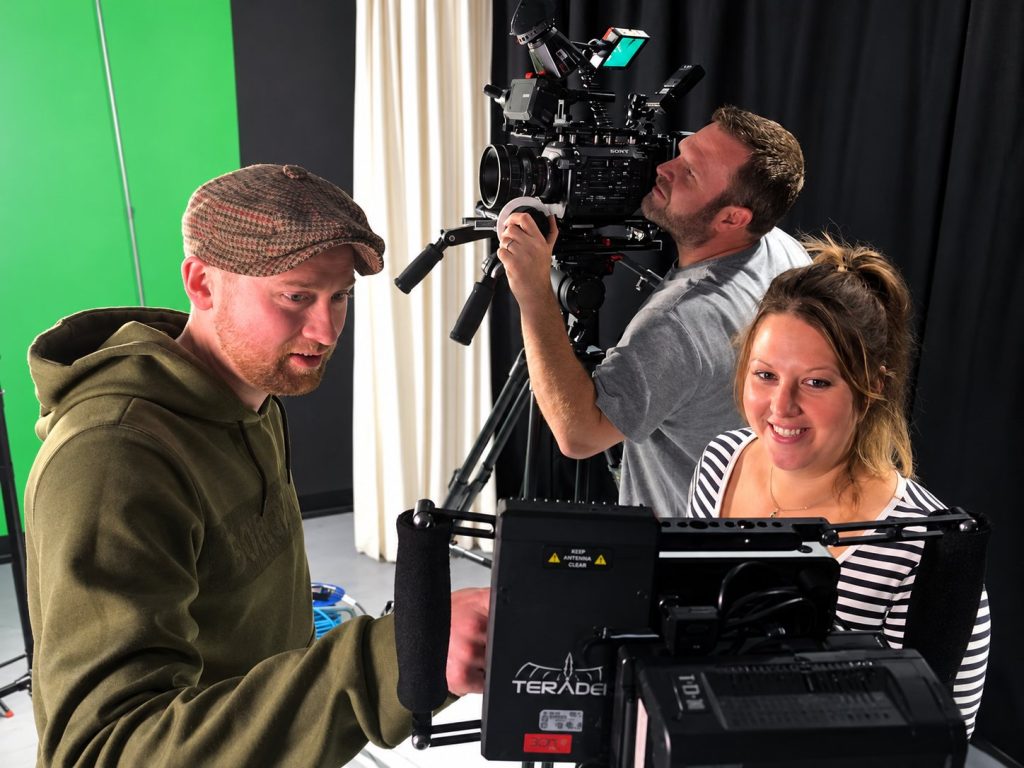
Lighting does more than anything else to make an advert look like an advert, and it’s usually what takes the longest to set up. The gaffer is the head of lighting, who works with the DOP to turn the look that’s been planned into an actual set-up of lights, and manages the lighting crew and the electrics. A spark is a lighting technician who works under the gaffer, setting up and moving the lights and running the power to them.
The sound operator, also called the sound recordist, captures the dialogue and any other sound on set, usually with a microphone on a long pole held just out of shot, and small microphones hidden on the actors. If nobody speaks on camera and the advert is going to be carried by music and a voiceover, a shoot can sometimes manage without a sound operator altogether.
The art department, wardrobe and make-up
The art director looks after everything you see in the shot that isn’t a person: the set, the furniture, the colours and the props. On a bigger production they may work under a production designer and lead a team of their own. Much of the job is making a real place look right for the story. When we produced Metrocentre’s Christmas commercial for the agency AL Marketing, the house used for the final scenes had no decorations, so our art director rearranged the rooms, put up and decorated the tree, and added festive touches throughout.
When a location doesn’t exist or can’t be used, a set builder constructs it. That might be a single wall for a studio shot or a whole room. On larger shoots there’s also a dedicated props person, who finds, prepares and looks after every object the cast handle or that appears in shot.
The wardrobe stylist chooses what everybody on camera wears, and makes sure it fits the character, suits the brand and stays the same from one shot to the next. The hair and make-up artist gets the cast ready for camera and keeps them looking the same throughout the day. Keeping things consistent like this is called continuity, and it matters more than you’d think when a thirty-second advert is filmed over many hours and out of order, because a collar that’s up in one shot and down in the next is exactly the kind of thing viewers notice.
After the shoot
Once filming is finished, the work passes to a smaller group of people who do their jobs at a screen instead of on a set. The editor puts the advert together, choosing the best takes and cutting them into a version that tells the story in exactly the right number of seconds. The colourist then adjusts the colour and contrast of the finished edit, which is known as grading, so that every shot matches and the advert has a consistent, polished look.
The motion graphics and VFX artist creates anything that’s added to the picture afterwards, from on-screen text, prices and logos through to visual effects, which is what VFX stands for. On an animated advert the animator brings the characters and the world to life, and on a live-action one they may create individual animated elements that sit alongside the filmed footage.
The soundtrack comes last, when the sound designer and the dubbing mixer build the finished version, balancing the dialogue, the music, the voiceover and the sound effects so that it sounds right on a television. On a smaller production, one or two people may cover several of these jobs, and we’ve written separately about how the stages after the shoot fit together.
And the people who aren’t crew
You’ll also find people on a shoot, or involved afterwards, who aren’t part of the crew at all. The actors, presenters and extras who appear on camera are known as the cast or the talent, and the voiceover artist, who records the voice you hear over the pictures in a studio once the edit is nearly finished, is talent too. The people on camera don’t have to be professionals, although choosing between real people and actors takes some thought. If there are children in the cast, there’ll be a chaperone as well, whose only job is to look after them.
You and your team are very welcome on set as well. Most clients like to come along for at least part of the day, and it’s useful to have somebody there who can answer questions about the business. We’ve written a guide to the shoot day for clients, so that you know what to expect.
Do you need all of these people?
You almost certainly don’t, and you shouldn’t pay for people the advert doesn’t need. Most of these jobs still have to be done on every shoot, but with a simple idea a handful of people can cover them between them, and it’s only as the idea grows that more of them need somebody’s full attention. On the smallest shoots there may be only two people, a producer who also directs and a DOP who also operates the camera, and on a big shoot you might have more than 20 crew.
You can see the range in our own work. Some of our adverts have been made with a small crew in a single day. The Metrocentre commercial, a two-day shoot, had a cast and crew of more than 20, and one of our biggest, a commercial for Hampson Hughes made with the agency Global, involved nearly 100 people once you counted the cast, the crew and the extras.
What decides it is the idea, so once we know what the advert needs to achieve, we’ll put together the right crew for the job, and you won’t need to manage any of them. If you’d like to see how the whole thing fits together, have a look at The Process, or ask us for a free storyboard.
Keep reading.

What happens at a TV ad shoot? A guide for clients
If you’ve never been on a film set, the shoot day can be a bit of a mystery. Here’s what…

What happens after the shoot? Post-production explained
Filming is only half the job, so here’s what happens in the edit, what you’ll be asked to approve at…

Can I use my existing video as a TV ad?
A promotional or social media video can sometimes go on TV, though rarely exactly as it is. Here’s what usually…
Ready when you are.
Tell us a little about what you're hoping to achieve and we'll take it from there.
Let's talk about your campaign