


For most of our clients, the shoot is the first time they’ve been on a film set, and it’s usually the part of the whole process they’re most looking forward to and most nervous about. Even if you’ve sat in on a corporate video being made, a TV advert tends to be slower and more painstaking, with more people and more equipment devoted to far fewer seconds of screen time. So here’s what the day is really like, and how to get the most out of being there.
You’re welcome to be there
We like having clients on set, because you know your business better than anyone, and it’s far easier to answer a question there and then than to find out in the edit that something wasn’t right. When we produced Metrocentre’s Christmas commercial for the agency AL Marketing, the centre’s own marketing team were with us all day, keeping things running smoothly and making sure that every brand appearing in the advert had approved its involvement, which is the kind of help only a client can give.
You don’t have to stay all day, but we’d suggest being there for the important scenes, which usually means the ones that show your product, your premises or your people. If you can’t make it, send somebody who knows the business well and can say yes or no on your behalf, because a question that has to wait for an answer can keep a whole crew standing around.
Most of the decisions have already been made
By the time anyone arrives, the planning is done. The script and storyboard are approved, the cast and locations are booked, and there’s a schedule setting out what’s being filmed and when. The key people will usually have been to each location already, on a visit known as a recce, to work out where the camera and the lights will go.
You’ll get a call sheet before the shoot, which is the document that gives everybody the address, the timings and who’ll be there. All of that planning is why the shoot isn’t the moment to rethink the idea, because everything from the lighting to the lunch break has been arranged around the shots on the storyboard.
It starts early, and it starts slowly
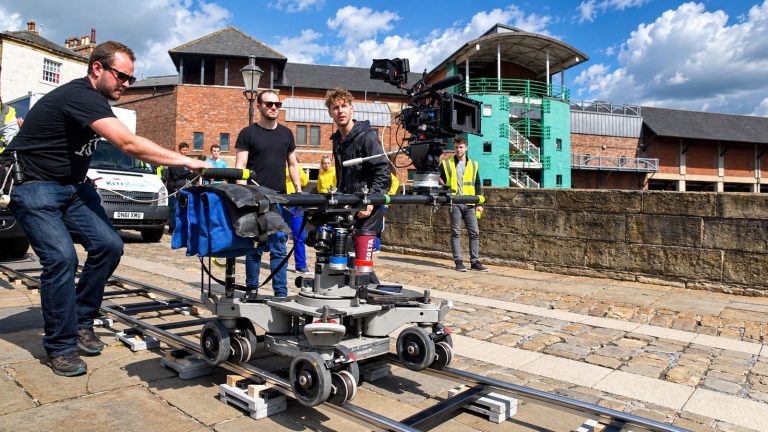
The crew usually arrives well before filming begins. The first hour or two goes on unloading, setting up the camera and lights, and getting the first shot to look right, while the cast are in make-up and wardrobe. From the outside it can seem as though nothing is happening, which is normal.
How many people are there depends on the job. A small shoot might be two people and a big one could be twenty or more, and we’ve written a guide to who they all are.
Why thirty seconds can take all day

The thing that surprises people most is that a thirty-second advert can take a whole day, and sometimes more than one, to film. The reason is that an advert is filmed one shot at a time, and for each one the camera moves, the lights are adjusted and the scene is reset, which is known as a set-up. The shot is then filmed several times over, each attempt being a take, so that there’s a choice in the edit. The same moment is often filmed from more than one angle as well, and that’s what lets the editor cut from a wide view to a close-up of a face or a product.
Things are filmed in the most practical order, too, which is rarely the order of the story. Everything that happens in one place, or under one arrangement of lights, is shot together, so the scenes in your reception might all be filmed before lunch even though one of them opens the advert and another closes it.
On top of that come the things nobody controls. Sound, weather, traffic and aeroplanes all cause delays, because a take that was perfect in every other way still has to be done again if a lorry rumbled past in the middle of it. On the second day of the Metrocentre shoot it rained all morning, which wasn’t what we wanted for the outdoor scenes, but the skies cleared in the afternoon and we got some beautiful light at exactly the right time.
Add all of that together and a few seconds of finished footage an hour is a perfectly normal rate. It’s slow because getting it right on the day is much cheaper than fixing it later, once the cast, the crew and the location have all gone.
What you’ll be asked
There’ll be a monitor where you can watch what the camera sees. The director or producer will check in with you at key points, usually when a shot involves your product, your premises, your staff or anything about how the business is shown. Those are the things only you can judge, because the crew will know whether a shot is sharp and well lit, but they won’t know that the packaging changed last month or that your fitters never go on site without their ID badges.

The most helpful thing you can do is to speak up early. If the logo is wrong, a product is out of date or something isn’t how you do it, say so straight away, because once the crew has moved on to the next set-up, going back means building the last one all over again. It works best if you pass your comments to the producer and not directly to the cast or crew. That keeps the set calm and the messages clear, since an actor who’s getting notes from two directions doesn’t know which to follow. If several of you are coming, agree beforehand who speaks for the business, for the same reason.
Try to trust the plan as well, because a single shot can look odd on its own, such as an actor smiling at nothing or a product filmed against a bare wall, when it’s been designed to work with the shots either side of it. The storyboard will show you where it fits. If a new idea occurs to you on the day, do mention it, because sometimes a great one turns up. Everything extra takes time from what’s already planned, though, so it’s best raised gently with the producer, who’ll know whether there’s room for it.
If we’re filming at your premises
Filming takes over a space, so expect equipment, cables and people, and expect the area to be out of use while we’re there. It helps to warn staff and customers, sort out parking, and have someone on hand who has the keys and can answer questions. If sound is being recorded, you may also be asked to turn off background music, phones or noisy machinery for a few minutes at a time.
If your own staff are appearing, let them know in good time and make sure they’re happy to take part. It can work very well: when we made an advert for George Bolam Foods with the agency Dickinson Media, we cast the staff as the stars and shot the whole thing in a single day. How much you ask people to do on camera makes a big difference, though, and that’s the subject of our article on real people and actors.
If there are children or animals
Both come with extra rules, and both take longer. A child under school leaving age will usually need a performance licence from their local council. They can only work limited hours, and unless they’re with a parent or their teacher they have to be supervised by a chaperone the council has approved. The licences and the chaperone are arranged as part of the production, and the schedule is then built around the hours the children are allowed to work.
Animals need a handler or a vet on set, and there’s more on that in our article on animals in TV ads. None of this is a reason to avoid either, as long as it’s planned for from the start, and one of our adverts for Motor Depot, made with the agency PAB Studios, had a cast of twenty children and an actress playing their teacher.
What to bring
- Comfortable shoes and warm clothes, because sets are often cold and there’s a lot of standing about.
- Anything of yours that appears on camera, such as products, uniforms, signage and vehicles.
- A phone charger, and some work to do in the quiet spells.
Bring some patience as well, because a set can look chaotic to a visitor even though everybody on it knows exactly what they’re waiting for.
And when it’s finished
When the last shot has been filmed, the director will call a wrap, which is the signal that filming is over. The crew will pack up, and the footage goes to the edit. You’ll see a first version before long, and our guide to what happens after the shoot takes it from there, including what you’ll be asked to approve.
If you’re weighing up an advert of your own and wondering how big a shoot the idea would need, get in touch and we’ll give you an honest view.
Keep reading.
Who does what on a TV ad set? A guide to the crew
DOP, gaffer, grip, focus puller, DIT: a plain-English guide to the people who make a TV advert and what each…

What happens after the shoot? Post-production explained
Filming is only half the job, so here’s what happens in the edit, what you’ll be asked to approve at…

Can I use my existing video as a TV ad?
A promotional or social media video can sometimes go on TV, though rarely exactly as it is. Here’s what usually…
Ready when you are.
Tell us a little about what you're hoping to achieve and we'll take it from there.
Let's talk about your campaign