


If you’ve never had a TV advert made before, the hardest part is often picturing what you’re going to get. Someone can describe an idea to you for half an hour and you’ll still be imagining something different from what’s in their head. A storyboard fixes that, which is why it’s the first thing we make for anybody who’s thinking about advertising on TV.
What a storyboard is
It’s your advert drawn out scene by scene, a bit like a comic strip. Each frame shows what’s on screen at that moment, and underneath it you’ll find what’s being said, whether that’s a voiceover or a line from somebody on camera, along with any words that appear on screen. There’s often a note of what the camera is doing as well, such as moving in slowly on a face or cutting to a close-up of the product.
It isn’t meant to be a work of art, because the drawings are only there to show who’s in each shot, where they are and what’s happening, so that you can follow the advert from the first second to the last. Nobody in them will look much like the people who are eventually cast, and the colour and the lighting are left for later, so what you’re judging is the sequence of events and not the standard of the sketching.
The idea is older than television advertising, and according to Disney’s own A to Z, Webb Smith, one of the studio’s story men, is credited with coming up with it in the early 1930s. Story sketches were pinned in sequence to large boards, because the artists found a story much easier to picture that way than to read as a script. The practice spread from cartoons to feature films and then to commercials, and it has lasted for the reason it began, which is that people looking at the same pictures tend to agree about what they’ve seen, whereas people listening to the same description often don’t.
Why it’s worth doing first
The main reason is that changing a drawing costs almost nothing, and changing an advert after it’s been filmed can cost a great deal. If you look at the storyboard and feel the offer comes in too late, or the ending doesn’t land, or there’s a scene your customers wouldn’t recognise themselves in, that’s a five-minute conversation at this stage. The same thought on the day of the shoot means holding up a crew, and in the edit there may be nothing to fix it with, because the shot you now want was never filmed.
It also gets everybody agreeing on the same advert, which is harder than it sounds. Tell three people that the advert opens on a family arriving at the seaside, and one will picture toddlers, another teenagers and the third a retired couple, and each of them would be surprised by the casting. Once it’s drawn, you, your colleagues and our team are all looking at the same thing, so any disagreement comes out now and there are no surprises on the day.
Then there’s the question of whether the idea fits the time. Thirty seconds isn’t long, and laying an advert out frame by frame soon shows up one that’s trying to say too much, because you can see how little time each frame has to make its point. If there are more frames than the time will hold, something has to go, and it’s far better to choose what that is on paper. We’ve written separately about what each length of advert has room for.
A storyboard makes the shoot quicker as well, because the director and crew know exactly which shots they need, which matters a lot when you’ve only got a location for a few hours. PC Specialist’s national campaign, which we made with their agency, Forward & Thinking, had to cover four locations in two days, which gave us half a day in each. With so little time, the director, producer and director of photography visited every location beforehand and worked out the shots in advance, which is only possible when everybody already knows what has to be filmed. For the same reason, a storyboard is the first point at which a production can be costed with any confidence, since it shows how many locations, how many people and how many shots the idea needs.
It helps with approval, too, because every TV advert has to be cleared by Clearcast before it can be shown, and that starts with the script, so having the whole advert worked out early means problems come to light before anything’s been filmed. We’ve explained how that works in the Clearcast process explained.
What a storyboard can’t tell you
A storyboard is a plan, and a plan leaves things out. A drawing can’t show you a performance, so it won’t tell you how warm an actor’s smile is or how a line will sound when it’s spoken, and it can only hint at the pace and the music. Those are settled later, in the casting, on the shoot and in the edit.
The finished advert won’t match the drawings frame for frame either, because on the day a director will sometimes find a better angle than the sketch suggested, or the light will offer something nobody could have planned. What stays fixed is the story, the message and the order of events that you approved, because everything from the schedule to the lighting will have been arranged around them.
What happens after you’ve seen it
We’ll talk you through it rather than just sending it over, because it’s much easier to explain how a scene will look and sound in conversation. You tell us what you like and what you’d change, and we keep working on it until you’re happy. Show it at this point to anybody whose opinion will count later on, because a doubt that takes five minutes to deal with now is a much bigger matter once the advert has been made. Only once it’s agreed does anybody start planning a shoot or an animation.
From then on, the storyboard is what everybody works from. The shoot is planned around it, you can use it on the shoot day to see where each shot fits, and the editor’s first version puts the shots together in its order. If the advert is animated, the storyboard is the first of the four stages an animated advert goes through.
You can have one for free
We offer a storyboard free of charge to businesses that are seriously thinking about TV. It starts with a conversation, in which we’ll want to know about your business, who your ideal customer is, what would make them choose you over anybody else and what result you’re hoping for. Then we’ll come back with a storyboard showing, scene by scene, how your advert could look and what it would say, and talk you through it. There’s no commitment, and it makes it far easier to decide whether TV is right for you. You can ask for yours on our free storyboard page. If you’re at the stage before the storyboard, we’ve also written about how to write a brief for a TV ad.
Keep reading.
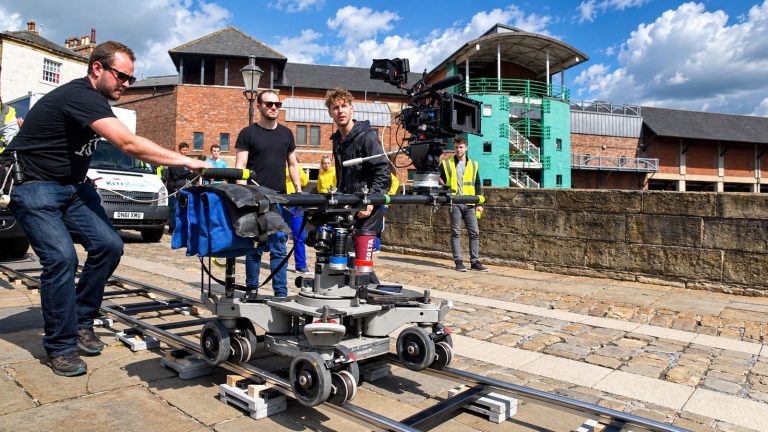
Who does what on a TV ad set? A guide to the crew
DOP, gaffer, grip, focus puller, DIT: a plain-English guide to the people who make a TV advert and what each…

What happens at a TV ad shoot? A guide for clients
If you’ve never been on a film set, the shoot day can be a bit of a mystery. Here’s what…

What happens after the shoot? Post-production explained
Filming is only half the job, so here’s what happens in the edit, what you’ll be asked to approve at…
Ready when you are.
Tell us a little about what you're hoping to achieve and we'll take it from there.
Let's talk about your campaign