


It’s a very reasonable question, because you’ve already paid for a promotional video, or you’ve got one on social media that did well, and it seems a waste not to put it on television. The honest answer is that it can sometimes be done, though rarely with the video exactly as it is, and how much has to change depends on a handful of things.
It’s far from a lost cause, and some of the adverts we’ve made contain nothing that was filmed for them. Our advert for Craig David’s 2019 summer tour, made with the agency Gibson Media, was built from clips of his past performances, and one for the NHS, made with the agency SD Advertising, combined material the client already had with a graphic effect created by our in-house designers. So the real question is what your particular video would need.
Is the quality good enough?
Television is unforgiving, and footage that looks fine on a phone can look soft or shaky on a fifty-inch screen. The broadcasters also have technical standards for the picture and the sound, and a file has to meet them before it will be accepted. Professionally shot footage from the last few years is usually fine, whereas footage filmed on a phone, or made only for social media, may not be.
What you still have matters almost as much as how it was shot. The copy on your website or your social channels has been squeezed down so that it loads quickly, and the loss of quality shows on a big screen, so we’d want the original full-quality file from whoever made it. Better still is the material it was made from, meaning the footage as it was before any music, voice or captions were added, because a finished video is a little like a baked cake. If the music and the voice are mixed together in one soundtrack, you can’t take one out and leave the other, and captions that have become part of the picture can’t be lifted off again.
Does it fit a TV slot?
A video that passes on quality still has to fit the space. Airtime is sold in fixed lengths, usually 10, 20, 30 or 60 seconds, and an advert has to run to exactly that length, to the frame. It also needs to be in the 16:9 widescreen format, so anything shot vertically or square for social media will need reframing, and a vertical video shows such a narrow slice of the scene that there often isn’t enough picture to fill a television with.
Most longer videos can be cut down to fit, and there’s often a strong thirty seconds in there. A sentence spoken at a relaxed pace in an interview doesn’t shorten neatly, though, and a story told over three minutes loses its thread when most of it is taken away. So it usually works best when it’s re-edited as an advert in its own right, with a clear beginning and end and often a new voiceover, so that the message still lands in the shorter time.
Do you have the rights?
This is where most existing videos come unstuck, because nearly everything in a video is licensed for a particular use, and television counts as a different and bigger one.
Music is the usual culprit, because a track licensed for online use is very unlikely to be licensed for broadcast, so it will need a new licence, or replacing. With library music that’s often a matter of paying for the wider licence, whereas licensing a well-known song is a much bigger undertaking, and sometimes the better answer is a piece written for you.
The same goes for the people in it, because actors, models and voiceover artists are paid for specific uses, and if television wasn’t in the agreement, they’ll need to be paid for it. Staff and customers who appear need to have agreed to it as well, and with an older video you’ll want to be sure that everybody in it still works for you and would be glad to turn up on television. If a customer is praising you on camera, there are rules about testimonials to meet as well.
Then there’s everything else in the picture, starting with stock footage and images, where many licences don’t cover TV advertising without an upgrade. Other companies’ brands may need their owners’ agreement as well, which a video made for another purpose is unlikely to have had. The footage itself is the last thing to look at, because you need to be sure that you own it, and not the company that filmed it, which comes down to what was agreed when it was made.
None of this is unusual, and it can usually be sorted out, but it has to be checked before anything goes to a broadcaster.
Will it get through Clearcast?
Once you know who owns what, the next question is what the video says. Nobody checks a video before it goes on your website, but on television every advert is checked first by Clearcast, which approves adverts on behalf of the broadcasters, and any claim has to be supported. A video that says you’re “the best in the region” or “the cheapest around” will need evidence, or the line will have to go.
A new advert goes through this as a script, before anything has been made, which is when changes are easy. An existing video arrives finished, so anything that can’t be supported has to be cut out or replaced, and that’s far simpler when the line is in a voiceover, which can be recorded again, than when somebody says it on camera.
There are also things it will need that it won’t yet have. Offers need their conditions shown on screen as supers, the advert has to pass the test for flashing images, and it will need subtitles, which for television are a separate file made by a specialist service, and not the captions you may have added for social media. We’ve explained the whole process in our guide to Clearcast, and it’s something we’d handle for you from start to finish.
Is it actually an advert?
The last question is the one people don’t expect, which is whether the video is really an advert at all. A video made for your website is speaking to somebody who’s already interested enough to be there, whereas a TV advert is speaking to somebody who’s never heard of you, in the middle of their favourite programme. Those are two different jobs, and a company video that explains everything you do at a gentle pace may not have the hook, the focus or the ending that an advert needs, however good it looks.
A video that did well on social media is a closer relation, but it was still made for different conditions. It was built to stop a thumb in its first moments, it’s often watched with the sound off, and the viewer can tap straight through to your website. On television the sound is on, the screen is across the room and nobody can click on anything, so the advert has to leave your name in the viewer’s head.
Suppose you had a three-minute video made for your website a couple of years ago, with aerial shots of the factory, an interview with the founder and a customer talking about the service. There’s very probably a television advert in that material, but it isn’t likely to be any thirty seconds that already exist. It would be the best handful of shots, a new voiceover written to make one point, and an ending that gives your name time to register.
So what are the options?
That leaves three routes, and the right one depends on how your video fared against the questions above. If the footage is strong and the rights can be cleared, we can re-edit it and cut a proper advert from it, with new graphics, voiceover and music where needed. This is the most affordable route onto TV, and we’ve written more about it in the cheapest way to advertise on TV. If there are gaps, we can add to it, keeping the best of what you have and shooting a few new scenes to fill them. And sometimes the honest advice is to start again, because it can be cheaper and better to make something new than to fix all the problems with something old.
Not sure which you’ve got?
Send us the video and we’ll tell you honestly what it would take. It costs nothing to ask, and it’s much better to know before you’ve booked the airtime, so get in touch whenever you’re ready. If it turns out to be nearer to ready than you expected, Clearcast clearance and subtitling are both things we can arrange for an advert that was made elsewhere.
Keep reading.
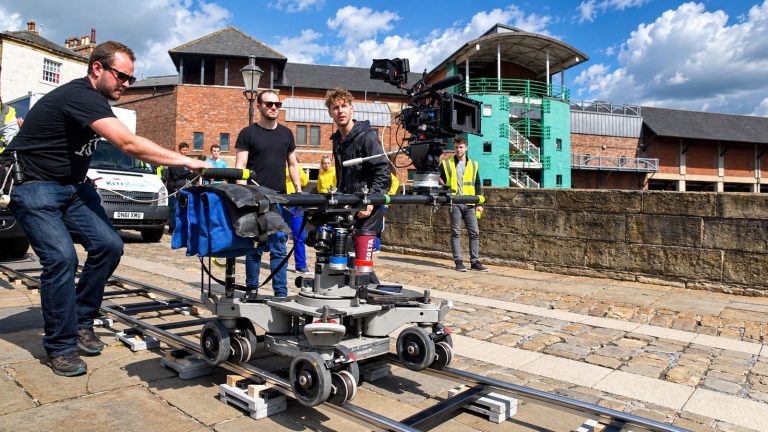
Who does what on a TV ad set? A guide to the crew
DOP, gaffer, grip, focus puller, DIT: a plain-English guide to the people who make a TV advert and what each…

What happens at a TV ad shoot? A guide for clients
If you’ve never been on a film set, the shoot day can be a bit of a mystery. Here’s what…

What happens after the shoot? Post-production explained
Filming is only half the job, so here’s what happens in the edit, what you’ll be asked to approve at…
Ready when you are.
Tell us a little about what you're hoping to achieve and we'll take it from there.
Let's talk about your campaign