

If you’re marketing a college, sixth form or university, you’re probably working to a recruitment target with a budget that never quite stretches, and competing with every other provider nearby for the same students. Funding follows the student, so the number who enrol in September matters to the whole institution, and a shortfall then is very hard to make up later.
You also have two audiences to win over, because parents and carers have as much say as the students do, and there are usually several people internally who all need to approve whatever you make. Education is one of the sectors we know best. We’ve made adverts for further education colleges, sixth forms and specialist schools, and this is what we’ve learned about making TV work for them.
Students and parents don’t watch in the same way
Very few people choose a college or a university entirely on their own. In a poll for the Office for Students in 2018, 71% of prospective university students said they turned first to their parents for advice, more than said the same of teachers, friends or websites, and a sixteen-year-old choosing between your college and a school sixth form is hardly likely to be consulting them less. That makes a lot of education marketing awkward, because the places where you reach teenagers are mostly not the places where you reach their parents, and one side of the conversation often hears nothing at all.
Television helps because it reaches the household, although it reaches the two generations by different routes. Parents still watch plenty of ordinary broadcast TV, so airtime in your ITV region will find them. Younger viewers favour streaming services and YouTube, but much of that is watched on the television in the living room. Ofcom’s Media Nations 2026 report found that 76% of the time 16 to 34-year-olds spent watching video at home in 2025 was spent in front of a TV set.
The broadcasters’ streaming services, such as ITVX, are particularly useful here, because younger audiences watch more of their television that way and the advert can be shown only to households in your catchment area. We’ve written a separate guide to advertising by postcode. The same advert can also be recut for YouTube and social media, and we make those versions too.
Picture a family on a weekday evening in October, with a Year 11 student half-watching and a parent who’s been meaning to ask what she wants to do next year. If an advert for your open evening comes on, the conversation you needed them to have starts by itself, and it starts with your name in it. Everybody else in the area sees it too, and a college that’s on television is seen as confident and successful, which helps you with employers and partners as well as applicants.
Planning around the recruitment calendar
Most advertisers have to guess when their customers will be making up their minds, and you don’t, because open days, application deadlines, results and clearing come round at the same points every year. A typical pattern is a campaign in the weeks before each open day, another around the main application period, and a final push around results day and clearing.
The last of those is easy to underestimate, because an application isn’t an enrolment. Plenty of sixteen-year-olds apply to more than one place and make their real choice in the days after GCSE results, when their grades have turned out better or worse than they expected and every plan is open again. For universities, clearing squeezes a great deal of deciding into a week or two. Advertising in late summer speaks to the students who haven’t chosen you yet, and also to the ones who have and need reminding why they did. Summer tends to be one of the cheaper times of year to buy airtime as well, which we explain in our piece on how airtime prices move through the year.
What makes a college advert work
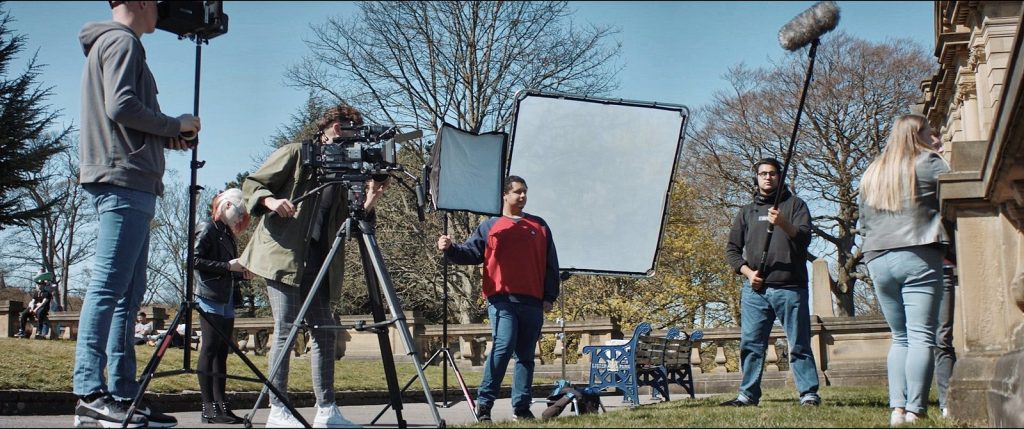
Whenever it runs, the adverts that work best feel like the place. Real students are nearly always more convincing than actors, and one clear feeling does more than a list of courses, because trying to squeeze the whole prospectus into thirty seconds never works. When South Tyneside College had invested in its facilities and wanted to show new applicants what to expect, we filmed real students so that viewers would get a genuine sense of the community they’d be joining. We covered the huge range of courses with strong shots and a clever edit instead of trying to name them all. (We’ve written more about choosing between real people and actors.)
Being bold helps as well, because school and college adverts tend to share a look, and viewers have seen it many times. Queen Alexandra Sixth Form asked us for something completely different to what people expect when a school or college comes on screen, and we answered with a striking animation style, bold on-screen messages and an electric music track, which stood out as soon as it was broadcast. Our advert for South Shields Marine School, which sets students up for a career in the Merchant Navy, was built on dramatic visuals, a strong voiceover and music, because the courses are hands-on and exciting and we wanted the advert to feel the same way. It won Best Commercial at the Royal Television Society Awards, and it did so by having a strong idea and committing to it.
A strong idea doesn’t always need a shoot, either. During lockdown, when we couldn’t film anything new, we made a campaign for South Tyneside College from stock footage, with superhero-themed graphics and a new message that made it the college’s own.
The work can show up in the numbers as well, and Bradford College is the clearest example we have. The college wanted a fresh campaign that felt like Bradford, built around the city and its students, and we produced it with the agency Forward & Thinking. The campaign generated a 474.5% increase in views of the college’s clearing webpage compared with 2017/2018, and the college went on to exceed its recruitment targets.
Sometimes the audience is parents alone, as it was for AE Publications, whose advert for their 11+ and SATs practice books we also made with Forward & Thinking.
What needs settling before filming
Every TV advert is checked before it goes on air, by Clearcast on behalf of the broadcasters, and in education most of the checking is about claims. Pass rates, rankings, satisfaction scores and Ofsted grades all need evidence and usually a date, so have the source to hand. Comparisons with other providers need the most care, as six universities found in November 2017, when the Advertising Standards Authority upheld complaints against all of them over marketing claims such as being a “top 1% world university”. In most of those cases there was a real ranking or set of figures behind the claim, but it didn’t quite say what the university said it did.
Ofsted claims need a second look as well, now that the new report cards used in England since November 2025 grade a range of areas on a five-point scale and no longer give a single overall judgement. A headline grade from an earlier inspection needs its date beside it, and a newer report can’t be summed up in one word. We handle the clearance for you, and wording like this is checked at the script stage, when it’s still easy to change.
The filming itself is far easier in term time, when the campus looks busy, so an advert for a campaign in August has to be filmed before the students leave for the summer. If students under 18 are going to appear, the right permissions have to be in place beforehand and the filming has to fit around their timetable.
Approval is the other thing to settle early. Many institutions have several people who need to sign off the advert, from the principal and the governors to heads of department who’d each like their own subject to feature, and agreeing at the start who has the final say saves a great deal of time. A storyboard helps a lot here, because everybody can see the advert as drawings and have their say while a change still costs next to nothing.
Start with your dates
Bring us your key dates for the year and a view on what you’d like local people to think of you, and we’ll come back with a storyboard, free of charge, that you can put in front of your colleagues. Ask for a free storyboard or get in touch to begin, and have a look through our education work to see how different one college’s advert can be from another’s.
Keep reading.
TV advertising for healthcare and dental practices
If you’re marketing a healthcare or dental practice, you need nervous people to trust you, and you’re working under stricter…

How to advertise on ITV in your region
You don’t have to buy the whole country to be on ITV. Here’s how its regions work, how the airtime…
TV advertising for retailers and shopping centres
If you’re marketing a shop or a shopping centre, the only question is whether more people came through the door.…
Ready when you are.
Tell us a little about what you're hoping to achieve and we'll take it from there.
Let's talk about your campaign