

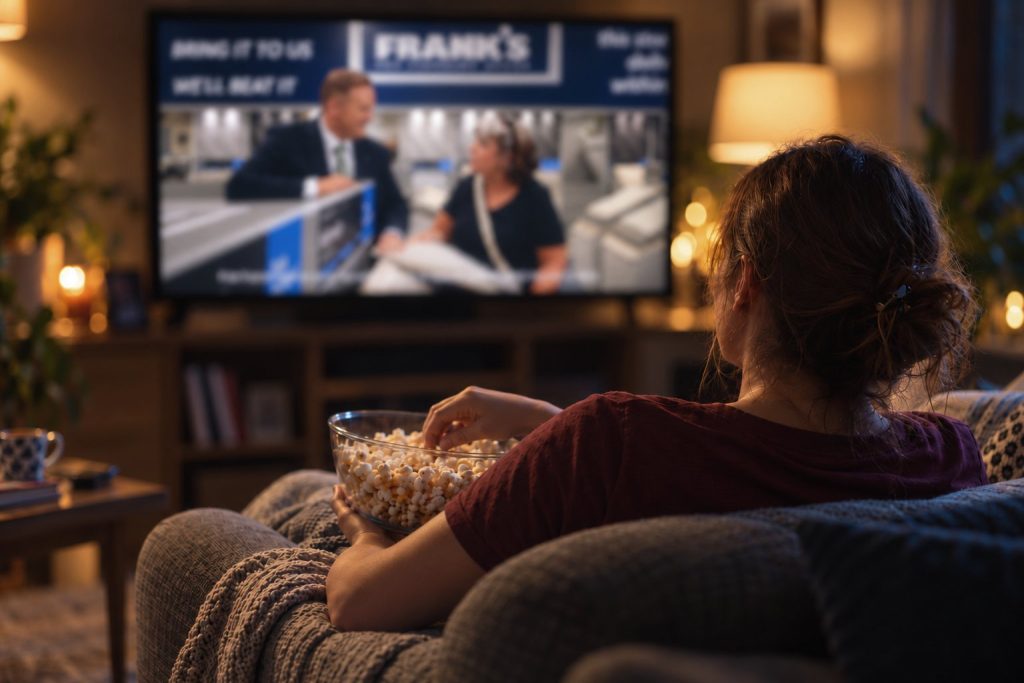
Think about the last advert you saw on your phone. You were almost certainly on your own, and you almost certainly didn’t mention it to anybody. Now think about the last time an advert came on while you were watching telly with someone else, when there’s a decent chance that one of you said something.
That’s one of the big differences between TV and nearly every other kind of advertising, because most adverts reach people one at a time and TV still reaches a lot of them together. It doesn’t do so as reliably as it did when a household had one set and four channels, and we’ll come to that, but it happens often enough to change what an advert can do.
The sofa effect
Most of us do it without thinking. An advert comes on for a restaurant and somebody says, “That looks nice, we should go there.” A holiday advert starts a conversation about next summer, or a new kitchen appears on screen and one of you gives the other a look. Sometimes it’s only “I can’t stand this one,” but even that means you’ve both noticed it.
Those little conversations matter a great deal, because most of the bigger decisions in a household aren’t made by one person. Where to eat, which sofa to buy, who to call about the windows and where to send the kids to college are all things people talk over, and an advert that both of you have seen is already part of that conversation.
Follow that through and you can see where TV differs most from advertising that’s aimed at one person at a time. Picture a holiday park whose online advert reaches one half of a couple on their phone at lunchtime. However good it is, that person now has to remember it, bring it up at home and make the park’s case to somebody who has never heard of it. If the two of them see the advert together, nobody has to persuade anybody that the place exists, and the conversation can start at “shall we have a look at that for half term?” A decision that needs two people to agree is much easier to win when both of them have heard about you at first hand.
There’s a wider version of the same thing. When you see an advert on television, you assume that plenty of other people have seen it too, so a business that advertises there becomes one that your neighbours and your in-laws have heard of as well as you. That counts for a lot when you’re about to let a firm into your house or pay a deposit, and it’s part of the reason TV is the most trusted place to advertise.
Do people still watch together?
A sceptic would say that all this describes the living room of twenty years ago, and there’s something in that. Plenty of viewing now happens alone, on a tablet in bed or a phone on the train, and even in a full living room somebody will be half watching while they scroll (we’ve written separately about whether that matters).
What hasn’t changed is the big screen in the living room, which is still where a household ends up together in the evening, whether the programme arrives through an aerial or over the internet. The programmes that draw the biggest audiences also tend to be the ones people make a point of watching in company, such as live sport, the big Saturday night shows and the drama that everybody at work is talking about.
If you want proof that television is a social thing, look at Gogglebox. It’s a hugely popular programme that consists entirely of people sitting on their sofas, watching television and talking to one another about it, and nobody has made a hit show about people scrolling through their phones in silence. The families on Gogglebox are doing what the rest of us do every evening, which is reacting, laughing, arguing and passing comment, and the adverts get exactly the same treatment in living rooms across the country.
And when enough people watch the same thing in the same week, it can still move the whole country in a way that very little else does. The faults in the Post Office’s Horizon computer system had been reported for years, and argued over in the courts, without ever becoming something that everybody talked about. Then ITV showed the drama Mr Bates vs The Post Office over four nights in January 2024, and within a week of the last episode the Government had announced a new law to clear the sub-postmasters who’d been wrongly convicted. That was a drama and not an advert, but it shows what the medium is still capable of when a lot of people see the same thing at the same time and talk to each other about it.
One view is often more than one viewer
Shared viewing also means that the audience for a TV advert is often bigger than the numbers suggest. On broadcast TV the audience figures count the people in the room, so anybody watching alongside you is already included. Streaming adverts are generally counted by the number of times they’re played, though, and when the screen is a television, there’s often more than one person in front of it.
Thinkbox, the marketing body for commercial TV in the UK, has published research on this, drawing on figures from ITV and Channel 4, who sell the airtime and so aren’t neutral either. In one example, looking at The Great British Bake Off on Channel 4’s streaming service, it found an average of 2.1 viewers for every view across the whole audience, and 1.5 among 16 to 34 year olds. Bake Off is about as close to family viewing as television gets, so we’d read that as towards the top end and not as the average. The figure will vary from one programme to the next, and for something watched late at night on a laptop it will be close to one. Even so, one play of your advert on a TV screen is quite often two or more people seeing it.
Compare that with an advert on a phone, where one view is one person, and probably one who’s about to scroll past. Whether the extra viewer is worth anything to you depends on what you sell. If it’s something a household decides on together, the second person on the sofa is exactly who you want to reach, and if it’s something people buy for themselves, they’re a bonus and no more than that.
What it means for your advert
If people are going to watch your advert together, it’s worth making one they’ll want to talk about. That doesn’t have to mean a big budget, but it does mean having an idea, whether that’s something funny, something useful or something that makes people say “we should look into that.”
Humour is the obvious example, because people laugh more readily in company and then repeat the joke to each other. Motor Depot have always been clear that they don’t want adverts that only talk about prices, and would much rather make people laugh and sell them a car at the same time. The advert we made with their agency, PAB Studios, puts a teacher in front of a class of twenty children, in a situation that happens to be resolved by buying a car from Motor Depot.
Watching together is also a good reason to make the next step easy to remember. If two people on a sofa agree that your place looks worth a visit, they need to be able to recall your name the following day, which is an argument for saying it clearly and for a name that’s simple to search for. And if what you sell is usually decided by more than one person, say so when the airtime is being planned, because programmes differ a lot in how many people watch them together.
That’s the sort of thing we think about from the very first conversation. If you’d like to see how we’ve done it for others, have a look at some of our work, or ask us for a free storyboard.