

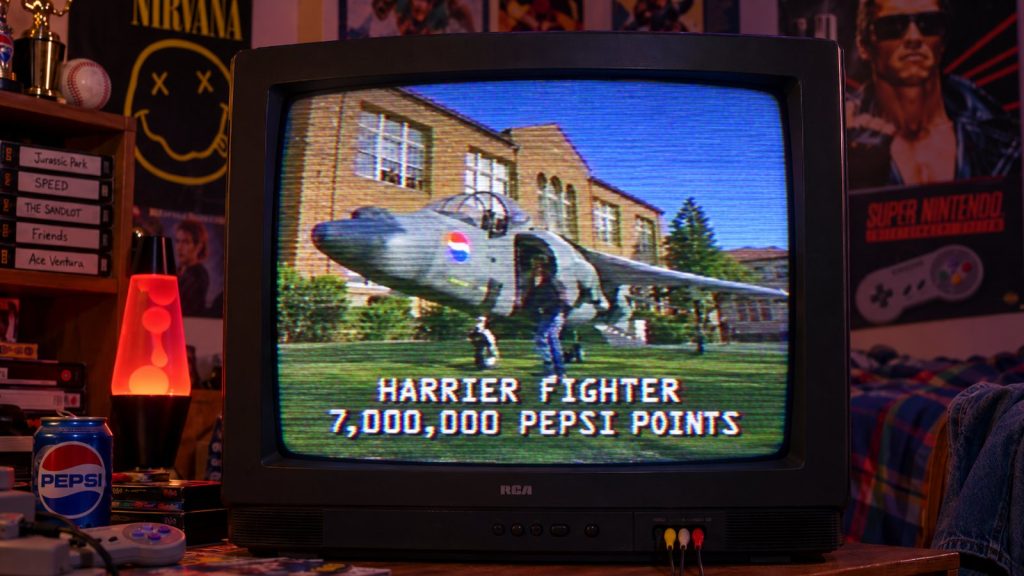
Every so often an advert gets its maker into trouble that nobody saw coming. Our favourite example is from the mid-1990s, when Pepsi put a fighter jet in a TV commercial as a joke and then found itself in court with a student who wanted to collect it.
The advert
Pepsi was running a loyalty promotion in the United States called Pepsi Stuff. You collected Pepsi Points from packs and exchanged them for branded merchandise, and the TV advert followed a teenager getting ready for school to demonstrate what was on offer. Each thing he put on was shown with its price in points on screen, to the sound of a military drumroll, so there was a T-shirt for 75 points, a leather jacket for 1,450 and a pair of sunglasses for 175.
The punchline comes when he gets to school, which he does by landing a Harrier jump jet beside the bike rack, with a Pepsi in his hand and no helmet on. A final caption, set out in the same way as the other three, puts the price of the jet at 7,000,000 Pepsi Points. It was obviously meant as a gag, a ridiculous prize to finish on, and the trouble was that nothing on screen said so.
The student who did the sums
A 21-year-old business student called John Leonard watched the advert and took it at face value. He lived in Seattle, in the corner of the country where Pepsi tried the promotion out from October 1995 before taking it nationwide. The order form in the catalogue listed 53 items and the jet wasn’t among them. Collecting seven million points by drinking Pepsi was never going to happen either (the court later worked it out at roughly 190 Pepsis a day for a hundred years), but he had spotted something in the catalogue’s small print. As long as you sent in at least 15 points of your own, you could buy any extra ones you needed for 10 cents each.
Seven million points at 10 cents works out at roughly $700,000, and a Harrier jet was worth tens of millions of dollars, so on paper it was a remarkable bargain. Leonard found an investor to put up the money, a friend called Todd Hoffman, and in March 1996 he sent off his 15 points with an order form on which he’d written “1 Harrier Jet” in the space for the item. The cheque that went with it was for $700,008.50, which covered the points he was short of and $10 for postage and handling.
What Pepsi did next
Pepsi sent the cheque back with a letter explaining that the jet wasn’t part of the offer and had only been put in to make the advert funny, and it enclosed some coupons for free Pepsi to make up for the confusion. Leonard didn’t see the funny side, and his lawyers wrote back to demand the aircraft. It was Pepsi that went to court first, asking a judge in New York to confirm that it didn’t owe anybody a jet, and Leonard then sued for breach of contract in the case that became known as Leonard v. Pepsico.
The ruling came in August 1999, more than three years after Leonard had posted his cheque, and as his local paper reported, it went Pepsi’s way. The first of the judge’s reasons was that an advert of that kind isn’t a binding offer in the first place, because all it does is invite you to send for the catalogue, and the catalogue had no jet in it.
The second was that no reasonable person could have believed the advert was a serious offer of a military aircraft. This is the part of the judgment that’s unexpectedly good fun to read, because Judge Kimba Wood had to explain, patiently and at some length, why a joke was a joke. She described the teenager as “a highly improbable pilot” who could barely be trusted with the keys to his parents’ car, pointed out that a jet built to attack targets on the ground is not a sensible way of getting to school, and observed that an aircraft costing roughly $23 million was hardly going to be on offer for $700,000. The appeal court agreed with her the following year, and Leonard never got his jet.
Pepsi did change the advert along the way, though, first by putting the price up to 700 million points and then by adding the words “Just Kidding” on screen, which rather suggests they wished they’d done it the first time.
The Netflix documentary
The whole saga was turned into a four-part Netflix documentary in 2022, called Pepsi, Where’s My Jet? It features John Leonard, Todd Hoffman and the people who worked on the campaign, and it’s a very entertaining watch if you have any interest in advertising, as the trailer shows.
The series is on Netflix, and Netflix has also published its own explainer of the court case. The moment in the series that anybody who makes adverts will find hardest to watch belongs to Michael Patti, the creative director on the campaign at Pepsi’s agency, BBDO. As Fast Company’s account of the series tells it, he says the storyboard originally priced the jet at 700 million points, and that a client found a number of that length hard to read on screen, so it was trimmed to 70 million and then to seven. At the original figure the points would have cost $70 million to buy, which is more than the jet was worth, and nobody would ever have heard of John Leonard.
Could it happen here?
It’s a lot less likely, and the reason is the clearance process. In the UK, a TV advert has to be approved by Clearcast before it goes on air, and prices, offers and promotions are exactly the kind of thing they look at closely. The joke itself wouldn’t be the difficulty, because the advertising code allows for obvious exaggeration that viewers are unlikely to take literally, and we’ve written separately about where that line falls. What would be questioned at script stage is a prize shown with a price next to it, and you’d be asked either to be able to honour it or to make it plain that it wasn’t real. That’s the job done by supers, the small text at the bottom of the screen, and two words of it would have saved Pepsi several years of legal bills.
It’s as well that somebody checks, because the English courts have been known to hold an advertiser to its word. In the 1890s the Carbolic Smoke Ball Company advertised a £100 reward for anybody who caught influenza after using its product, and added that it had deposited £1,000 with its bank to show that it was sincere. When a customer called Mrs Carlill used it and caught flu all the same, and the company argued that the advert had only been sales talk, the Court of Appeal made it pay, largely on the strength of that line about the bank. Judge Wood discussed the case in her Pepsi ruling, because the question in both was whether a reasonable person would think the advertiser meant it.
What we take from it
Jokes and exaggeration are a big part of what makes adverts enjoyable, and nobody wants them taken away. What went wrong for Pepsi had very little to do with the joke, which the judge had no trouble recognising. The difficulty was that it had been dressed as an offer, with a price on screen in the same style as the real ones, and that a rule in the catalogue, written for people who were a few points short of a T-shirt, made that price one a determined person could pay. Each of those decisions was reasonable when it was made, including the one to shorten a number so that it was easier to read, and they only became a problem when somebody read them together as literally as he could.
That’s the useful part for anybody planning an advert with an offer in it. Viewers can take you at your word, especially when there’s a number on the screen, so an offer needs to be one you’re prepared to stand behind, and it needs reading against its own terms and conditions after the last small change to the script has been made. Pepsi won comfortably, and it still spent more than three years in court over a gag that people are retelling thirty years later.
It’s one of the reasons we sort out the claims and the conditions before a script is signed off, and why we’d always choose a quick conversation with Clearcast over a letter from somebody’s solicitor. If you’ve got an offer in mind, or a joke you’re not sure how viewers would take, get in touch and we’ll tell you honestly how we think it would be read.
Keep reading.
The UK’s ten most memorable ad slogans, and what they have in common
The ASA asked the public which advertising slogans they remember best. Here is the top ten, and what any business…

Christmas TV adverts 2023: our first reactions
Mark and Peter sit down to watch the Christmas TV ads of 2023 for the first time and say what…
The government wants a closer look at Sky buying ITV
The Culture Secretary says she is minded to intervene in Sky’s takeover of ITV. Here’s what she has said, what…
Ready when you are.
Tell us a little about what you're hoping to achieve and we'll take it from there.
Let's talk about your campaign